Brahmi Ghee (Brahmi Ghrita)
Ayurvedic Medicated Recipe
Overview
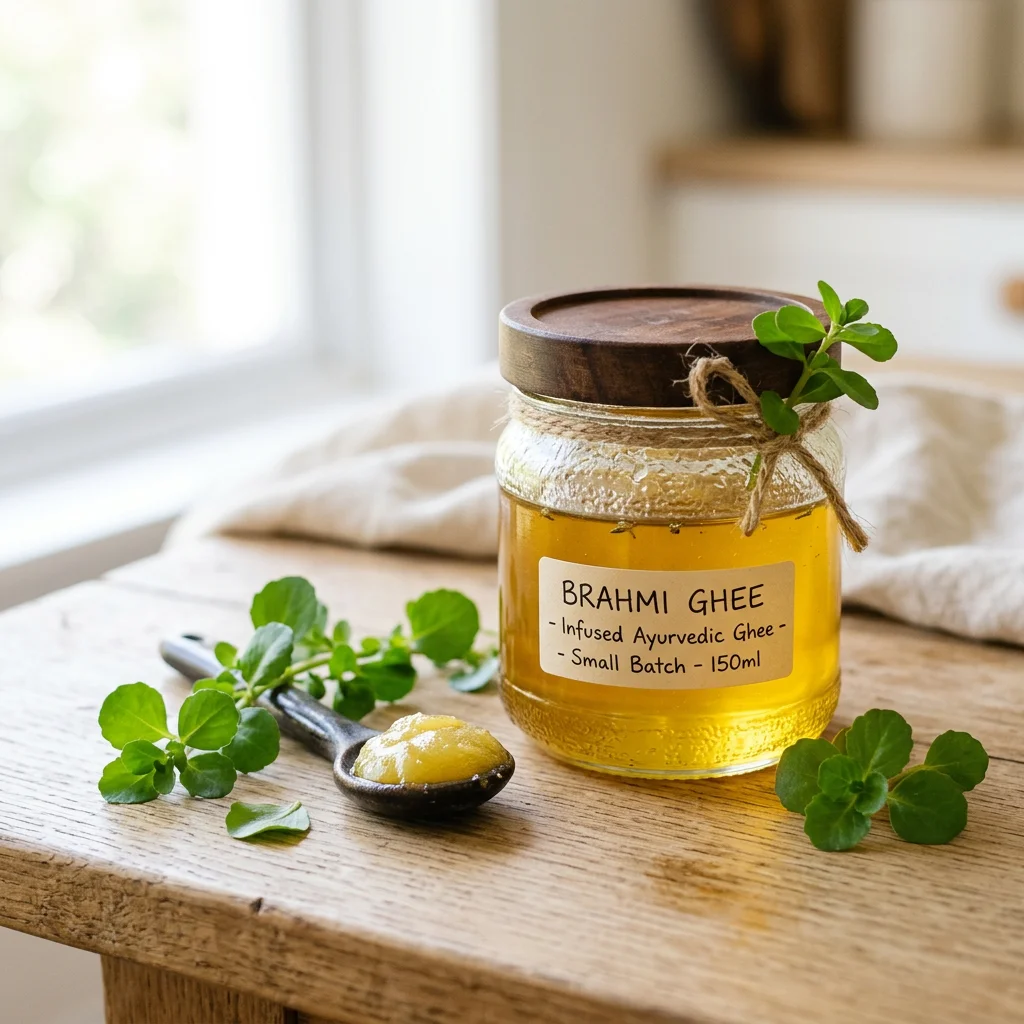
Brahmi ghrita is one of Ayurveda's most revered medicated ghee preparations — a slow-infused clarified butter carrying the full spectrum of brahmi's (Bacopa monnieri) cognitive and nervine properties into the deepest tissues of the body. Unlike brahmi taken as a powder or tea, the ghee preparation is specifically designed to cross the blood-brain barrier. Ghee is classified in Ayurveda as a yogavahi — a carrier substance that enhances the properties of whatever it carries while simultaneously delivering fat-soluble compounds to lipid-rich tissues like the brain and nervous system. The preparation process itself is therapeutic: brahmi paste is simmered in ghee with a measured quantity of water over the lowest possible heat until all the water evaporates. This ancient extraction method — requiring patience, attention, and a full day of gentle tending — concentrates the water-soluble bacosides and fat-soluble triterpenes into the ghee simultaneously. The result is a pale green-gold butter with a distinctly herbaceous, slightly bitter aroma that becomes the foundational nervine medicine in an Ayurvedic practitioner's pharmacopoeia. Brahmi ghee is prescribed for conditions ranging from anxiety and insomnia to poor memory, speech difficulties, and epilepsy. Its action is medhya — a specific Ayurvedic term meaning "that which enhances intellect and memory." Only four herbs in the classical texts receive this designation: brahmi, shankhpushpi, guduchi, and yashtimadhu (licorice). Of these, brahmi in ghee form is considered the most potent and the most broadly applicable.
Tridoshic when prepared properly. Particularly beneficial for Vata and Pitta affecting the mind. Mildly increases Kapha in excess.
Primary nervine tonic and medhya rasayana (intellect-enhancing rejuvenative). Indicated for anxiety, insomnia, poor memory, difficulty concentrating, speech disorders, ADHD-like patterns, emotional processing difficulties, and nervous system depletion. Classical indications include unmada (psychosis), apasmara (epilepsy), and all disorders of majja dhatu (nerve tissue). Used in 90-day therapeutic cycles for deep nervous system restoration.
Ingredients
- 1 cup Ghee (organic, unsalted)
- 1 cup Fresh brahmi leaves (packed, or 4 tbsp dried brahmi powder)
- 4 cups Water (filtered)
- 1 tsp Fresh ginger (grated)
- 1/4 tsp Black pepper (freshly ground, enhances absorption)
- 1/4 tsp Cardamom (ground, balances bitter taste)
Instructions
- If using fresh brahmi leaves, wash thoroughly, then blend with 1 cup of the water to form a smooth paste. If using dried powder, whisk it into 1 cup of water until smooth with no lumps.
- Melt ghee in a heavy-bottomed saucepan over the lowest possible heat. A thick stainless steel or cast iron pan distributes heat most evenly.
- Add the brahmi paste to the melted ghee. Add the remaining 3 cups of water, grated ginger, black pepper, and cardamom. Stir to combine.
- Maintain the lowest possible simmer — the surface should barely move, with only occasional small bubbles. Never let it reach a rolling boil, which destroys the delicate bacosides.
- Cook uncovered, stirring every 30 minutes, for approximately 5-6 hours. The water will slowly evaporate. You will hear the mixture shift from a watery bubble to a quieter, deeper sound as the water disappears.
- The ghee is ready when all water has evaporated and the herb residue begins to lightly fry in the pure ghee. Test by dropping a tiny amount of the mixture onto a flame — if it sputters, water remains. If it burns cleanly, the water is gone.
- Remove from heat immediately when the water is fully evaporated. Do not allow the herbs to brown or burn, which creates ama.
- Strain through a fine muslin cloth or multiple layers of cheesecloth into a clean, dry glass jar. Press the cloth to extract every drop of medicated ghee.
- Allow to cool completely before sealing. Store at room temperature away from light and moisture. Properly made brahmi ghee remains potent for up to one year.
How This Recipe Affects Each Dosha
Vata
Brahmi ghee is one of the most important medicines for Vata disorders of the mind — anxiety, racing thoughts, insomnia, inability to focus, and mental fatigue. The ghee base provides the heavy, oily, and warm qualities that ground Vata, while brahmi's cooling nature calms the overheated nervous system that drives Vata mental agitation. The combination addresses Vata's root pattern: too much movement in the mind, too little stability. Regular use over 90 days can fundamentally shift entrenched Vata mental patterns.
Pitta
Brahmi's cooling virya makes it particularly suited for Pitta mental imbalances — irritability, critical thinking that becomes harsh judgment, perfectionism, and inflammatory conditions of the brain. The ghee further cools and soothes. The bitter taste purifies excess Pitta from rakta dhatu (blood tissue), which directly affects mental clarity. This is the primary preparation for Pitta-type burnout: the high-performing mind that has overheated itself.
Kapha
The ghee base adds unctuousness that can increase Kapha if taken in excess. However, brahmi's light and penetrating qualities partially counteract this. For Kapha mental patterns — dullness, attachment, resistance to change, mental fog from excess moisture — brahmi ghee can be transformative when dosed carefully. The bitter taste is specifically anti-Kapha, clearing the heavy mental coating that Kapha types experience as brain fog.
Ghee is the supreme agni-supportive fat in Ayurveda — it stimulates digestive fire without adding inflammatory heat. Brahmi ghee specifically enhances the subdosha of agni called sadhaka pitta, which governs the "digestive fire of the mind" — the capacity to process experiences, emotions, and information. Weak sadhaka pitta manifests as inability to "digest" difficult experiences, leading to accumulated mental ama (unprocessed emotional residue). Regular use of brahmi ghee strengthens this mental digestive capacity while the physical ghee base supports jatharagni (main digestive fire) in the gut. The black pepper and ginger prevent the ghee from dampening digestive fire, a concern with any fat-based preparation.
Nourishes: Majja (nerve tissue), Shukra (reproductive tissue), Meda (fat tissue)
Adjustments by Constitution
For Vata Types
Take with warm milk sweetened with a small amount of honey for maximum Vata-grounding effect. Add a pinch of nutmeg to the milk for enhanced sleep support. The full 1-teaspoon dose is appropriate for most Vata types. Evening dosing is especially beneficial for Vata insomnia.
For Pitta Types
Take on an empty stomach with room-temperature water or cool milk. Omit the ginger from the preparation, as it adds unnecessary heat. Increase cardamom slightly for its cooling, Pitta-soothing quality. The morning dose is most beneficial for Pitta, supporting clear-headed composure throughout the day.
For Kapha Types
Take with warm water and a pinch of trikatu (long pepper, black pepper, ginger) to counteract the heavy ghee base. Use the smaller dose (1/2 teaspoon). Morning dosing on an empty stomach is best, as it stimulates mental clarity during Kapha's naturally sluggish morning hours. Avoid taking with milk, which adds unwanted Kapha-increasing heaviness.
Seasonal Guidance
Brahmi ghee can be taken year-round due to its tridoshic nature, but dosing and timing should shift with seasons. In autumn (Vata season), take the full dose twice daily with warm milk — this is when mental Vata accumulation peaks and brahmi ghee is most needed. In winter, continue full dosing to maintain nervous system resilience. In spring, reduce to once daily as Kapha accumulation makes the ghee base heavier. In summer, the cooling brahmi is especially welcome, but Pitta types should take it with cool water rather than warm milk to prevent overheating.
Best time of day: Morning on an empty stomach for cognitive enhancement. Evening 30 minutes before sleep for nervous system restoration. Can be taken at both times for therapeutic protocols.
Cultural Context
Brahmi ghrita appears in the Charaka Samhita, the oldest surviving Ayurvedic text, as a primary treatment for unmada (psychiatric disorders) and apasmara (epilepsy). Its preparation is described with meticulous precision — the ratio of herb to ghee to water, the duration of cooking, the signs of completion — reflecting a pharmacological sophistication that Western herbal medicine would not achieve for another two millennia. In the gurukula tradition, brahmi ghee was given to young students to enhance memory and learning capacity during their years of intensive study. The preparation's association with Saraswati, the goddess of knowledge and creative arts, elevates it beyond mere medicine into the realm of sacred practice. Making brahmi ghee is itself considered a form of sadhana — spiritual practice — because the hours of patient tending cultivate the very mental qualities the medicine is designed to enhance.
Chef's Notes
This is not a casual kitchen project — brahmi ghrita demands the slow, attentive presence that mirrors the meditative awareness it is designed to cultivate. The critical skill is temperature control: too high and the bacosides denature; too low and the extraction is incomplete. A heat diffuser between the burner and pot is invaluable. Traditional practitioners use an earthen pot (mitti ka bartan) which naturally regulates temperature and adds trace minerals. Dosing: 1/2 to 1 teaspoon twice daily, taken on an empty stomach or stirred into warm milk. For children (ages 5+), use 1/4 teaspoon. Begin with the smaller dose and increase over two weeks. Best taken for 90-day cycles with 30-day rest periods. Consult an Ayurvedic practitioner before use during pregnancy or alongside psychiatric medications.
Frequently Asked Questions
Is Brahmi Ghee (Brahmi Ghrita) good for my dosha?
Tridoshic when prepared properly. Particularly beneficial for Vata and Pitta affecting the mind. Mildly increases Kapha in excess. Brahmi ghee is one of the most important medicines for Vata disorders of the mind — anxiety, racing thoughts, insomnia, inability to focus, and mental fatigue. Brahmi's cooling virya makes it particularly suited for Pitta mental imbalances — irritability, critical thinking that becomes harsh judgment, perfectionism, and inflammatory conditions of the brain. The ghee base adds unctuousness that can increase Kapha if taken in excess.
When is the best time to eat Brahmi Ghee (Brahmi Ghrita)?
Morning on an empty stomach for cognitive enhancement. Evening 30 minutes before sleep for nervous system restoration. Can be taken at both times for therapeutic protocols. Brahmi ghee can be taken year-round due to its tridoshic nature, but dosing and timing should shift with seasons. In autumn (Vata season), take the full dose twice daily with warm milk — this is when
How can I adjust Brahmi Ghee (Brahmi Ghrita) for my constitution?
For Vata types: Take with warm milk sweetened with a small amount of honey for maximum Vata-grounding effect. Add a pinch of nutmeg to the milk for enhanced sleep sup For Pitta types: Take on an empty stomach with room-temperature water or cool milk. Omit the ginger from the preparation, as it adds unnecessary heat. Increase cardamo
What are the Ayurvedic properties of Brahmi Ghee (Brahmi Ghrita)?
Brahmi Ghee (Brahmi Ghrita) has Bitter, Sweet, Astringent taste (rasa), Cooling energy (virya), and Sweet post-digestive effect (vipaka). Its qualities (gunas) are Light, Oily, Penetrating, Subtle. It nourishes Majja (nerve tissue), Shukra (reproductive tissue), Meda (fat tissue). Ghee is the supreme agni-supportive fat in Ayurveda — it stimulates digestive fire without adding inflammatory heat. Brahmi ghee specifically enhances the subdosha of agni called sadhaka pitta, which governs the "digestive fire of the mind" — the capacity to process experiences, emotions, and information. Weak sadhaka pitta manifests as inability to "digest" difficult experiences, leading to accumulated mental ama (unprocessed emotional residue). Regular use of brahmi ghee strengthens this mental digestive capacity while the physical ghee base supports jatharagni (main digestive fire) in the gut. The black pepper and ginger prevent the ghee from dampening digestive fire, a concern with any fat-based preparation.
What should you eat today?
This recipe has specific effects on each dosha, and the right meal depends on more than general guidelines. Your constitution, the current season, your birth chart's active planetary period, what you ate yesterday, how you slept — it all matters.
With Personal Alignment, you get daily food and meal guidance tailored to:
- Your prakriti and current vikriti
- Your Vedic birth chart and active planetary cycles
- The season, weather, and time of day
- Your food preferences, allergies, and restrictions
- Your feedback — it learns what works for your body and adapts
Not a generic diet plan. A living system that gets smarter about you every day.