Frijoles de Olla (Mexican Pot Beans)
Mexican Recipe
Overview
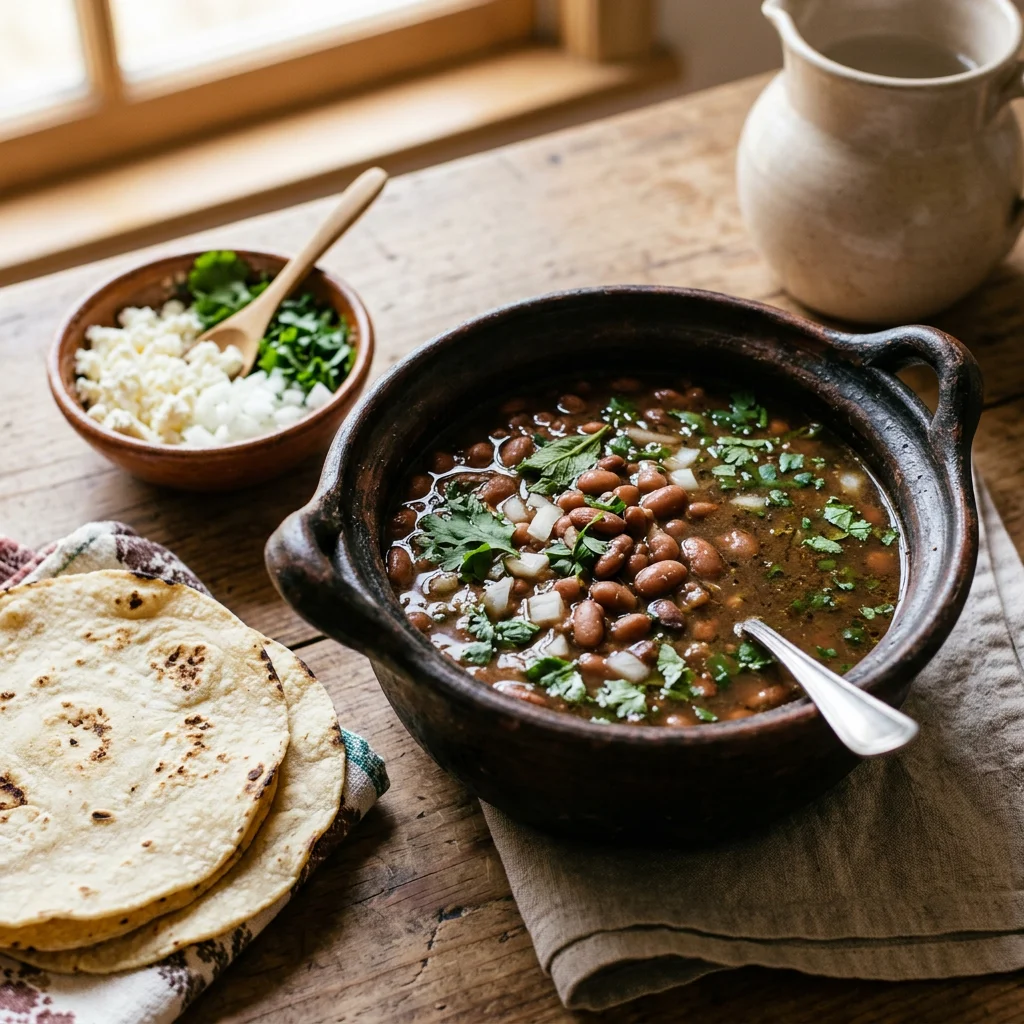
Frijoles de olla — beans from the pot — is the foundational dish of Mexican cuisine. Before the tacos, before the mole, before any of the elaborate preparations that define regional Mexican cooking, there are beans simmering in a clay pot with onion, garlic, and perhaps an herb or two. This is the dish that has sustained Mexican families for thousands of years, predating the arrival of European ingredients and persisting unchanged through every culinary evolution since. The method is disarmingly simple: dried beans go into a pot with water, aromatic vegetables, and salt, then cook slowly until tender. What emerges is not just cooked beans but a complete dish — the beans themselves, plump and creamy, swimming in a broth (caldo) that is almost as prized as the beans. Mexican families drink the caldo on its own, use it to thin salsas, and consider it a healing tonic. Nothing about the beans is wasted. From an Ayurvedic perspective, frijoles de olla is a masterwork of grounding nourishment. Beans are sweet and astringent, with a heavy quality that provides stability and tissue-building energy. The long, slow cooking in the clay pot (or heavy pot) breaks down their complex fibers, making them far more digestible than quick-cooked preparations. The epazote herb traditionally added in central Mexico serves a deeply practical purpose: it is one of nature's most effective carminatives, reducing the gas-producing tendency of beans.
Good for Vata when cooked thoroughly with fat. Can increase Kapha in excess. Neutral to mildly beneficial for Pitta.
Ingredients
- 500 g Dried pinto beans (rinsed and picked over)
- 1 medium Onion (quartered)
- 4 cloves Garlic (whole, peeled)
- 1 tbsp Dried epazote (or 3 fresh sprigs if available)
- 1 tbsp Sea salt
- 3 L Water
- 1 whole Serrano chile (optional, for mild heat)
- 1 tbsp Lard or olive oil (optional)
Instructions
- Rinse the beans thoroughly and pick through them, discarding any stones or broken beans. There is no need to soak — Mexican tradition holds that unsoaked beans produce better caldo.
- Place the beans in a large clay pot or heavy-bottomed pot. Add 3 liters of cold water, the quartered onion, whole garlic cloves, and the serrano chile if using.
- Bring to a boil over high heat, then reduce to a gentle simmer. Cover with a lid slightly ajar.
- Simmer for 1.5 to 2 hours, checking occasionally and adding hot water as needed to keep the beans submerged. Never add cold water — it shocks the beans and toughens their skins.
- When the beans are nearly tender (taste one — it should yield but still have some firmness), add the salt and epazote. Adding salt earlier can toughen the skins.
- Continue cooking for another 20-30 minutes until the beans are completely soft, creamy, and the caldo has turned a rich, opaque pink-brown. The broth should be plentiful — this is not a dry dish.
- Taste and adjust salt. Serve in deep bowls with plenty of caldo, accompanied by warm tortillas, lime wedges, and fresh salsa.
How This Recipe Affects Each Dosha
Vata
Beans are notoriously Vata-aggravating due to their dry, gas-producing quality, but frijoles de olla is the exception. The extremely long cooking, the epazote (nature's carminative), and the rich caldo transform these beans into a Vata-friendly food. The sweet taste and heavy quality provide genuine grounding nourishment.
Pitta
Generally suitable for Pitta. Pinto beans have a mildly cooling post-digestive effect, and the simple preparation avoids inflammatory ingredients. The optional serrano chile should be omitted for Pitta-sensitive individuals. A squeeze of lime at serving adds cooling sour taste.
Kapha
The heaviness and sweet taste of well-cooked beans can increase Kapha. The starchy caldo adds further building quality. However, the astringent taste in beans provides some drying action that partially offsets the heaviness. Best in moderate portions for Kapha types.
The long cooking pre-digests the beans' complex starches, significantly reducing their burden on agni. Epazote further supports digestion by reducing gas formation. The caldo itself is easily absorbed and nourishing. However, very large portions can still challenge weak digestion.
Nourishes: Rasa (plasma), Mamsa (muscle), Meda (fat), Asthi (bone)
Adjustments by Constitution
For Vata Types
Add a tablespoon of lard or olive oil to the pot while cooking. Increase the epazote. Serve with warm corn tortillas and a drizzle of lime. A few slices of avocado on top provide extra grounding unctuousness.
For Pitta Types
Omit the serrano chile. Add a sprig of fresh cilantro at serving. Squeeze lime generously over the bowl. Use black beans instead of pinto for a slightly more cooling effect.
For Kapha Types
Use black beans (lighter and more astringent than pinto). Add an extra serrano chile and increase the garlic. Serve with less caldo and more beans. Squeeze lime generously and top with raw diced onion and chopped cilantro for pungent, stimulating quality.
Seasonal Guidance
Frijoles de olla is a year-round staple in Mexico, though its warming, heavy quality makes it most appropriate for cooler months. In autumn and winter, enjoy generous portions with warm tortillas. In spring and summer, lighten the dish by serving smaller portions with more caldo and plenty of fresh lime, cilantro, and raw onion. During the hottest weeks of summer, consider serving the bean broth alone as a light, nourishing drink. The dish adapts to every season because it is so fundamental — it is not seasonal food but foundational food.
Best time of day: Lunch or early dinner, giving the heavy beans time for full digestion
Cultural Context
Frijoles de olla is arguably the oldest continuously prepared dish in the Americas. Beans were domesticated in Mesoamerica at least 7,000 years ago, and this method of simmering them in pottery is essentially unchanged from pre-Columbian times. The clay pot (olla) is so central to the preparation that many Mexican families keep a dedicated bean pot that is never washed with soap — only rinsed — believing the seasoned interior contributes irreplaceable flavor. In rural Mexico, a pot of beans simmers on the back of the stove at all times, serving as the ever-present foundation upon which all other meals are built.
Chef's Notes
The single most important rule: never rush the beans. Low, steady heat is what transforms dried legumes into something creamy and silky. A clay pot (olla de barro) genuinely produces better results than metal — it distributes heat more evenly and contributes a subtle mineral flavor. If using a metal pot, choose the heaviest one you have. Mexican grandmothers insist on adding only hot water when topping up the pot, never cold. The caldo (bean broth) is considered medicinal — save every drop. Leftover beans become refried beans the next day: mash and fry in lard until a thick paste forms. Black beans can be substituted for pinto, producing a different but equally traditional version popular in southern Mexico.
Frequently Asked Questions
Is Frijoles de Olla (Mexican Pot Beans) good for my dosha?
Good for Vata when cooked thoroughly with fat. Can increase Kapha in excess. Neutral to mildly beneficial for Pitta. Beans are notoriously Vata-aggravating due to their dry, gas-producing quality, but frijoles de olla is the exception. Generally suitable for Pitta. The heaviness and sweet taste of well-cooked beans can increase Kapha.
When is the best time to eat Frijoles de Olla (Mexican Pot Beans)?
Lunch or early dinner, giving the heavy beans time for full digestion Frijoles de olla is a year-round staple in Mexico, though its warming, heavy quality makes it most appropriate for cooler months. In autumn and winter, enjoy generous portions with warm tortillas. In
How can I adjust Frijoles de Olla (Mexican Pot Beans) for my constitution?
For Vata types: Add a tablespoon of lard or olive oil to the pot while cooking. Increase the epazote. Serve with warm corn tortillas and a drizzle of lime. A few slic For Pitta types: Omit the serrano chile. Add a sprig of fresh cilantro at serving. Squeeze lime generously over the bowl. Use black beans instead of pinto for a slight
What are the Ayurvedic properties of Frijoles de Olla (Mexican Pot Beans)?
Frijoles de Olla (Mexican Pot Beans) has Sweet, Astringent taste (rasa), Heating energy (virya), and Sweet post-digestive effect (vipaka). Its qualities (gunas) are Heavy, Warm, Moist. It nourishes Rasa (plasma), Mamsa (muscle), Meda (fat), Asthi (bone). The long cooking pre-digests the beans' complex starches, significantly reducing their burden on agni. Epazote further supports digestion by reducing gas formation. The caldo itself is easily absorbed and nourishing. However, very large portions can still challenge weak digestion.
What should you eat today?
This recipe has specific effects on each dosha, and the right meal depends on more than general guidelines. Your constitution, the current season, your birth chart's active planetary period, what you ate yesterday, how you slept — it all matters.
With Personal Alignment, you get daily food and meal guidance tailored to:
- Your prakriti and current vikriti
- Your Vedic birth chart and active planetary cycles
- The season, weather, and time of day
- Your food preferences, allergies, and restrictions
- Your feedback — it learns what works for your body and adapts
Not a generic diet plan. A living system that gets smarter about you every day.