Okayu (Rice Porridge)
Japanese Recipe
Overview
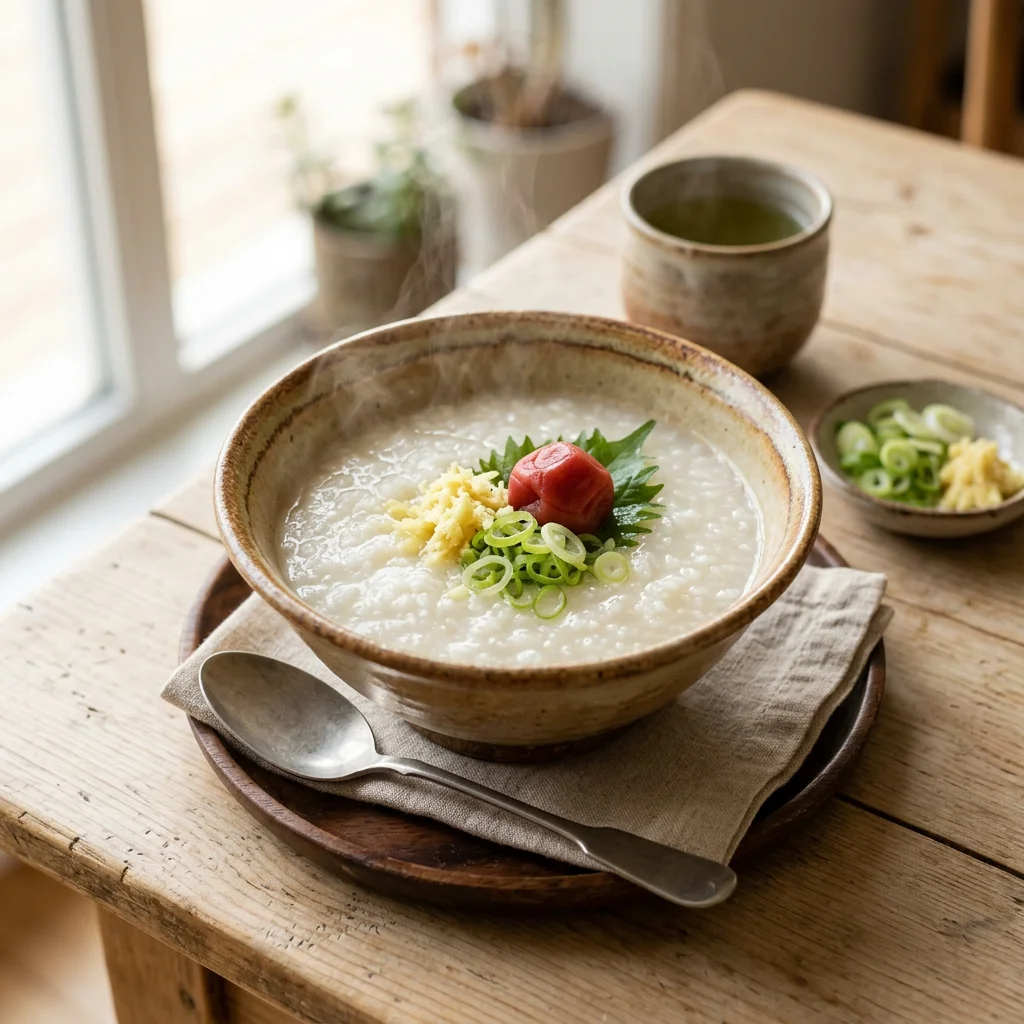
Okayu is Japanese rice porridge — short-grain rice simmered slowly in a large volume of water until the grains soften and partially dissolve into a silky, starchy broth. It is Japan's primary comfort and healing food, served to the sick, the elderly, recovering patients, and young children. Where kitchari is Ayurveda's therapeutic food, okayu fills the same role in Japanese folk medicine — the food you turn to when the body needs rest and gentle nourishment. The standard ratio is one part rice to five or seven parts water (5-bai gayu or 7-bai gayu), depending on the desired consistency. A 5:1 ratio produces a thick porridge where individual grains are still visible. A 7:1 ratio yields something closer to a thin gruel, ideal for those with severely compromised digestion. The cooking is slow and patient — 30 to 45 minutes of gentle simmering with minimal stirring, allowing the rice to release its starch gradually. From an Ayurvedic perspective, okayu is remarkably similar to the traditional Ayurvedic preparation called "peya" or "manda" — thin rice water prescribed during fever, digestive crisis, and panchakarma recovery. The principle is identical: reduce the grain to its simplest, most digestible form so the body can absorb nourishment without diverting energy to complex digestion.
Tridoshic when served warm. Balances all three doshas through its lightness, simplicity, and easily digestible nature. Especially calming for Vata and Pitta.
Primary recovery food during illness, fever, digestive distress, and post-surgical recovery. Japanese equivalent of Ayurvedic peya/manda. Used for infant weaning and elder care when solid foods are too demanding.
Ingredients
- 1/2 cup Short-grain Japanese rice (rinsed gently)
- 3.5 cups Water (7:1 ratio for thin porridge)
- 1/4 tsp Salt
- 1 whole Umeboshi (pickled plum) (for topping)
- 1/4 sheet Nori seaweed (torn into small pieces)
- 1 tsp Fresh ginger (finely grated)
- 1/2 tsp Sesame seeds (toasted)
- 1 stalk Scallion (thinly sliced)
Instructions
- Rinse the rice gently once — do not scrub vigorously, as you want to retain some of the surface starch that contributes to the porridge's silky consistency.
- Combine the rinsed rice and water in a heavy-bottomed pot. Cover and bring to a boil over medium heat.
- The moment it boils, reduce heat to the lowest possible setting. Slightly crack the lid to allow steam to escape, preventing boilover.
- Simmer for 30-40 minutes, stirring gently only once or twice during cooking. Excessive stirring breaks the grains too aggressively and creates a gummy texture rather than a creamy one.
- When the porridge has reached your desired consistency — the grains should be very soft and the liquid starchy and opaque — add the salt and stir gently.
- Ladle into bowls and top with umeboshi, grated ginger, torn nori, sesame seeds, and sliced scallion. Each person can adjust toppings to their taste.
How This Recipe Affects Each Dosha
Vata
The warm, soft, liquid quality of okayu is deeply soothing for Vata. It is one of the easiest foods for depleted Vata to digest, and the warmth calms Vata's cold, mobile nature. The starchy liquid coats and nourishes dry tissues. The umeboshi's sour taste directly pacifies Vata. A gentle, nurturing food for anxious or exhausted Vata types.
Pitta
Rice is one of the most cooling grains, and in this diluted, porridge form, it is even gentler on Pitta's sensitive digestion. The sweet taste and sweet vipaka directly pacify Pitta. The bland, uncomplicated nature provides rest for an overactive Pitta digestive system without any irritating spices or acids.
Kapha
Plain okayu is light enough to be acceptable for Kapha, though the watery, sweet, and soft qualities are not ideal as a daily food. Its therapeutic value for Kapha lies in acute situations — when digestion has shut down from illness and needs the gentlest possible restart. For daily eating, Kapha should add warming elements.
Extremely gentle on agni — this is the food for when agni is barely flickering. The pre-broken-down rice requires almost no digestive effort, allowing agni to recover. The warm temperature provides gentle stimulation without demanding anything. The grated ginger topping adds mild kindling without overwhelming weak digestion.
Nourishes: Rasa (plasma)
Adjustments by Constitution
For Vata Types
Cook in kombu dashi instead of plain water for mineral depth and umami grounding. Add a few drops of sesame oil to each bowl. Increase the grated ginger. Top with a soft-cooked egg (ontama) for nourishing protein. Include extra umeboshi for its sour, Vata-pacifying quality.
For Pitta Types
Keep it plain — the standard recipe is ideal for Pitta, especially during illness or digestive distress. Omit the ginger if Pitta is aggravated. Top with mild tsukemono (Japanese pickles that are not vinegar-heavy) and shiso leaves. Cook with a strip of kombu for mineral nourishment.
For Kapha Types
Add generous grated ginger and a pinch of shichimi togarashi to each bowl. Use less water (5:1 ratio instead of 7:1) for a thicker, less watery porridge. Top with sauteed mushrooms and nori for savory depth. Make this a transitional food, not a daily habit — move to firmer rice and drier preparations as digestion strengthens.
Seasonal Guidance
Okayu is appropriate year-round as a therapeutic food. In autumn and winter, it provides warmth and gentle nourishment during cold and flu season. In spring, a lighter version helps transition from winter heaviness. In summer, it can be served at room temperature as a light, hydrating meal during intense heat when appetite decreases. The seasonality of okayu is driven more by the person's condition than the calendar — it is medicine first, seasonal food second.
Best time of day: Breakfast for gentle morning nourishment, or any time during illness. In Japan, okayu is the go-to food at any hour when someone is unwell.
Cultural Context
Okayu occupies the same cultural space in Japan that chicken soup does in Western traditions — it is the universal food of healing and care. When a Japanese person falls ill, okayu with umeboshi is the first thing a family member prepares. It is the first solid food given to babies during weaning (starting from about 5 months), beginning as a very thin 10:1 ratio gruel and gradually thickening as the infant's digestion develops. Buddhist monasteries serve okayu as the morning meal during meditation retreats — its simplicity supports the practice of mindfulness. The act of making okayu for someone is itself an expression of care.
Chef's Notes
Resist the urge to stir frequently — this is the most common mistake. Okayu should simmer quietly, almost meditatively, with the rice releasing its starch into the water at its own pace. If the porridge becomes too thick, add hot water (never cold, which shocks the starch). The traditional sick-bed version is very plain — just rice, water, salt, and a single umeboshi. Add toppings and complexity only as the person's appetite and digestion recover. For a richer version (not for the sick), cook the rice in dashi instead of water and add a beaten egg stirred in at the end.
Frequently Asked Questions
Is Okayu (Rice Porridge) good for my dosha?
Tridoshic when served warm. Balances all three doshas through its lightness, simplicity, and easily digestible nature. Especially calming for Vata and Pitta. The warm, soft, liquid quality of okayu is deeply soothing for Vata. Rice is one of the most cooling grains, and in this diluted, porridge form, it is even gentler on Pitta's sensitive digestion. Plain okayu is light enough to be acceptable for Kapha, though the watery, sweet, and soft qualities are not ideal as a daily food.
When is the best time to eat Okayu (Rice Porridge)?
Breakfast for gentle morning nourishment, or any time during illness. In Japan, okayu is the go-to food at any hour when someone is unwell. Okayu is appropriate year-round as a therapeutic food. In autumn and winter, it provides warmth and gentle nourishment during cold and flu season. In spring, a lighter version helps transition from wi
How can I adjust Okayu (Rice Porridge) for my constitution?
For Vata types: Cook in kombu dashi instead of plain water for mineral depth and umami grounding. Add a few drops of sesame oil to each bowl. Increase the grated ging For Pitta types: Keep it plain — the standard recipe is ideal for Pitta, especially during illness or digestive distress. Omit the ginger if Pitta is aggravated. Top w
What are the Ayurvedic properties of Okayu (Rice Porridge)?
Okayu (Rice Porridge) has Sweet taste (rasa), Cooling energy (virya), and Sweet post-digestive effect (vipaka). Its qualities (gunas) are Light, Warm (from temperature), Soft, Liquid. It nourishes Rasa (plasma). Extremely gentle on agni — this is the food for when agni is barely flickering. The pre-broken-down rice requires almost no digestive effort, allowing agni to recover. The warm temperature provides gentle stimulation without demanding anything. The grated ginger topping adds mild kindling without overwhelming weak digestion.
What should you eat today?
This recipe has specific effects on each dosha, and the right meal depends on more than general guidelines. Your constitution, the current season, your birth chart's active planetary period, what you ate yesterday, how you slept — it all matters.
With Personal Alignment, you get daily food and meal guidance tailored to:
- Your prakriti and current vikriti
- Your Vedic birth chart and active planetary cycles
- The season, weather, and time of day
- Your food preferences, allergies, and restrictions
- Your feedback — it learns what works for your body and adapts
Not a generic diet plan. A living system that gets smarter about you every day.