Spanakopita (Greek Spinach Pie)
Greek Recipe
Overview
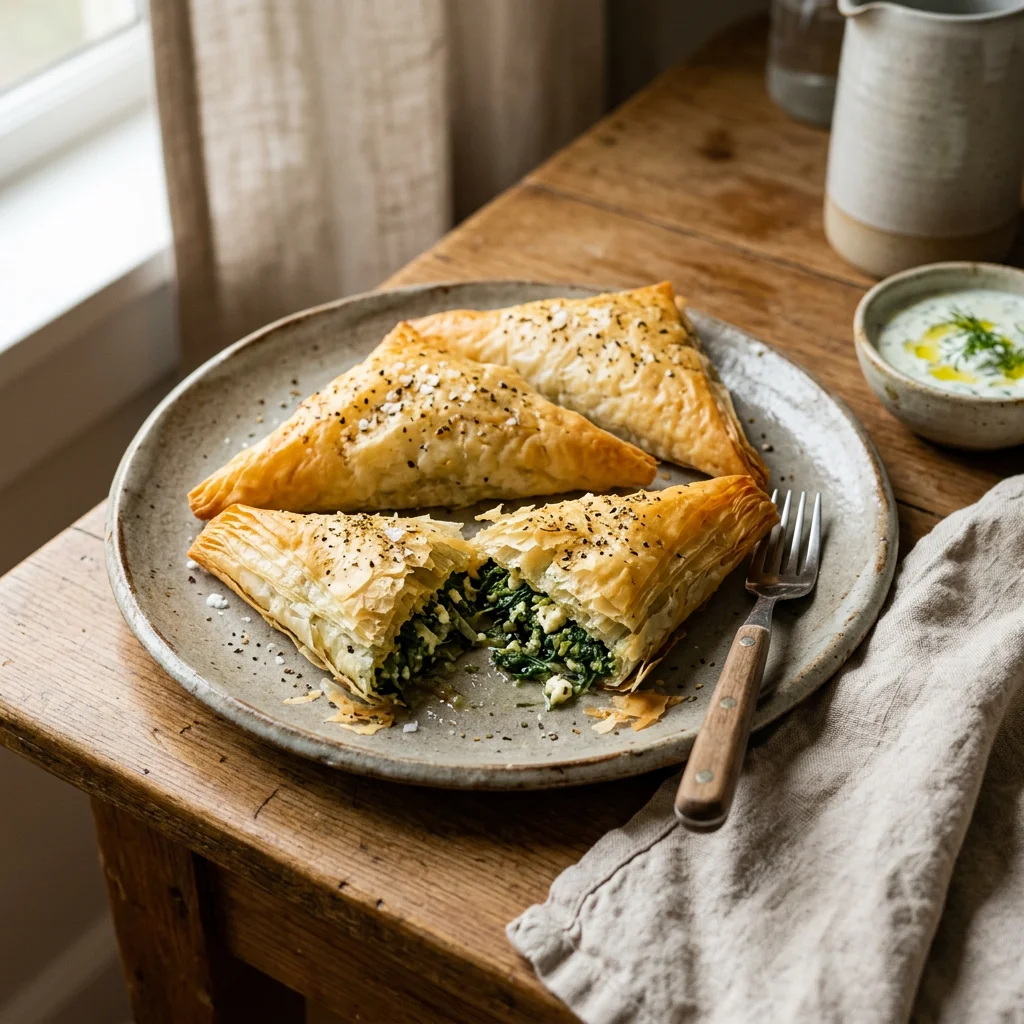
Spanakopita is the savory pie that defines Greek home cooking — layers of tissue-thin phyllo pastry encasing a filling of spinach, feta, herbs, and eggs, baked until the exterior shatters at the touch of a fork while the interior remains moist and intensely green. Every Greek household has a version passed down through generations, and the dish appears at celebrations, casual lunches, and everything in between. The filling balances the mineral depth of cooked spinach with the salty tang of feta, brightened by fresh dill and scallions. The phyllo layers, brushed with olive oil between each sheet, create a crust that is simultaneously delicate and substantial. Making spanakopita from scratch is a meditative process — the rhythmic brushing of phyllo, the careful layering, the generous filling — and the result rewards the effort many times over. In Ayurvedic terms, spanakopita is a study in balanced heaviness. The spinach provides iron and astringent taste, the feta offers salty and sour rasas, and the phyllo brings sweet and grounding wheat energy. The eggs bind everything while contributing building quality. The olive oil, worked between each layer, ensures the preparation is unctuous enough to satisfy without being sluggish.
Pacifies Vata well due to heaviness and oil. Can increase Pitta if eaten in excess. Tends to increase Kapha due to wheat, cheese, and oil.
Ingredients
- 1 kg Fresh spinach (washed and roughly chopped)
- 300 g Feta cheese (crumbled)
- 4 large Eggs (lightly beaten)
- 6 stalks Scallions (finely sliced)
- 1 bunch Fresh dill (finely chopped)
- 1/2 bunch Fresh parsley (finely chopped)
- 150 ml Olive oil
- 500 g Phyllo pastry (about 20 sheets, thawed if frozen)
- 1 medium Onion (finely diced)
- 1/4 tsp Nutmeg (freshly grated)
- 1 tsp Black pepper (freshly ground)
- 1 tsp Sea salt
Instructions
- Preheat the oven to 180C (350F). Wilt the spinach in a large pot over medium heat — no water needed beyond what clings from washing. Cook for 3-4 minutes, then drain in a colander, pressing firmly to extract as much moisture as possible.
- Warm 2 tablespoons of olive oil in a skillet and cook the onion and scallions until soft, about 5 minutes. Let cool slightly.
- In a large bowl, combine the drained spinach, crumbled feta, beaten eggs, cooked onions and scallions, dill, parsley, nutmeg, salt, and black pepper. Mix thoroughly.
- Brush a large baking pan (approximately 30x40 cm) with olive oil. Layer 10 sheets of phyllo across the pan, brushing each sheet generously with olive oil before adding the next. Let the edges hang over the sides.
- Spread the spinach filling evenly over the phyllo base. Fold any overhanging phyllo back over the filling.
- Layer the remaining phyllo sheets on top, again brushing each with olive oil. Tuck the edges down along the sides of the pan. Brush the top sheet generously with oil.
- Score the top layers into squares or diamonds with a sharp knife, cutting through just the top phyllo layers. Sprinkle a few drops of water over the surface to prevent the top from curling.
- Bake for 40-45 minutes until the phyllo is deep golden and crisp. Let rest for 10 minutes before cutting along the scored lines.
How This Recipe Affects Each Dosha
Vata
Very grounding for Vata. The combination of wheat pastry, olive oil, eggs, and cheese provides substantial nourishing heaviness. The warming nature and oily quality directly address Vata's cold and dry tendencies. The dill and scallions support digestive comfort.
Pitta
Moderately suitable for Pitta. The spinach is cooling and the feta provides satisfying salt, but the baked phyllo, eggs, and overall heating virya can increase Pitta in sensitive individuals. Best in moderate portions.
Kapha
The heaviest qualities of this dish — wheat pastry, generous oil, cheese — are precisely what Kapha should moderate. While the spinach and bitter herbs are beneficial, the overall preparation leans toward Kapha-increasing.
Moderately heavy on agni. The cooked spinach is easier to digest than raw, and the warming spices support digestion. However, the wheat, cheese, and egg combination requires strong digestive fire. Best eaten at midday.
Nourishes: Rasa (plasma), Rakta (blood), Mamsa (muscle), Asthi (bone), Majja (nerve)
Adjustments by Constitution
For Vata Types
This preparation is already well-suited for Vata. Add extra dill and a pinch of nutmeg in the filling. Serve warm with a drizzle of lemon juice to enhance digestibility.
For Pitta Types
Reduce the feta by one-third and increase the spinach. Replace scallions with fennel fronds. Add fresh mint to the filling. Serve at room temperature rather than piping hot.
For Kapha Types
Use half the olive oil between phyllo layers and reduce to 2 eggs. Add extra dill, a pinch of black pepper, and some dried oregano to the filling. Serve a smaller portion alongside a bitter green salad.
Seasonal Guidance
Spanakopita suits the cooler months best, from autumn through spring. In winter, its warming, heavy nature is deeply satisfying. During spring, when fresh spinach is abundant, the dish feels most alive and vibrant. In summer, the heavy phyllo and cheese can feel too dense — if craving it in warm weather, make a lighter version with extra herbs and less phyllo, or shape into small triangles for smaller servings. Greek cooks traditionally make the largest pies in winter and lighter individual pastries in warmer months.
Best time of day: Midday lunch or early afternoon when digestive fire is at its peak
Cultural Context
Spanakopita belongs to the vast Greek tradition of pites (pies), which are considered the soul of home cooking. Every region has its specialty pies — cheese pies, leek pies, wild greens pies — and spanakopita is the most beloved of all. It is central to Greek Orthodox Lent traditions (made without eggs and cheese during fasting periods), appears at Easter celebrations, Sunday family lunches, and name-day gatherings. In villages, making phyllo from scratch was a mark of domestic skill, with grandmothers stretching the dough paper-thin across large tables. The dish represents the intersection of frugality and abundance — simple greens transformed into something magnificent.
Chef's Notes
The single most important step is squeezing every drop of water from the cooked spinach. Wet spinach makes soggy spanakopita — squeeze it in handfuls until nothing more drips out. Keep the phyllo covered with a damp towel while working to prevent it from drying and cracking. Brush generously with oil between layers; parsimony here leads to dry, papery pastry. Spanakopita keeps well at room temperature for hours, making it ideal for gatherings. It can also be shaped into individual triangles for portable servings — fold strips of phyllo around tablespoons of filling in a flag-folding pattern.
Frequently Asked Questions
Is Spanakopita (Greek Spinach Pie) good for my dosha?
Pacifies Vata well due to heaviness and oil. Can increase Pitta if eaten in excess. Tends to increase Kapha due to wheat, cheese, and oil. Very grounding for Vata. Moderately suitable for Pitta. The heaviest qualities of this dish — wheat pastry, generous oil, cheese — are precisely what Kapha should moderate.
When is the best time to eat Spanakopita (Greek Spinach Pie)?
Midday lunch or early afternoon when digestive fire is at its peak Spanakopita suits the cooler months best, from autumn through spring. In winter, its warming, heavy nature is deeply satisfying. During spring, when fresh spinach is abundant, the dish feels most aliv
How can I adjust Spanakopita (Greek Spinach Pie) for my constitution?
For Vata types: This preparation is already well-suited for Vata. Add extra dill and a pinch of nutmeg in the filling. Serve warm with a drizzle of lemon juice to enh For Pitta types: Reduce the feta by one-third and increase the spinach. Replace scallions with fennel fronds. Add fresh mint to the filling. Serve at room temperature
What are the Ayurvedic properties of Spanakopita (Greek Spinach Pie)?
Spanakopita (Greek Spinach Pie) has Sweet, Salty, Astringent, Bitter taste (rasa), Heating energy (virya), and Pungent post-digestive effect (vipaka). Its qualities (gunas) are Heavy, Warm, Oily. It nourishes Rasa (plasma), Rakta (blood), Mamsa (muscle), Asthi (bone), Majja (nerve). Moderately heavy on agni. The cooked spinach is easier to digest than raw, and the warming spices support digestion. However, the wheat, cheese, and egg combination requires strong digestive fire. Best eaten at midday.
What should you eat today?
This recipe has specific effects on each dosha, and the right meal depends on more than general guidelines. Your constitution, the current season, your birth chart's active planetary period, what you ate yesterday, how you slept — it all matters.
With Personal Alignment, you get daily food and meal guidance tailored to:
- Your prakriti and current vikriti
- Your Vedic birth chart and active planetary cycles
- The season, weather, and time of day
- Your food preferences, allergies, and restrictions
- Your feedback — it learns what works for your body and adapts
Not a generic diet plan. A living system that gets smarter about you every day.