Steamed Bok Choy with Ginger
Chinese Recipe
Overview
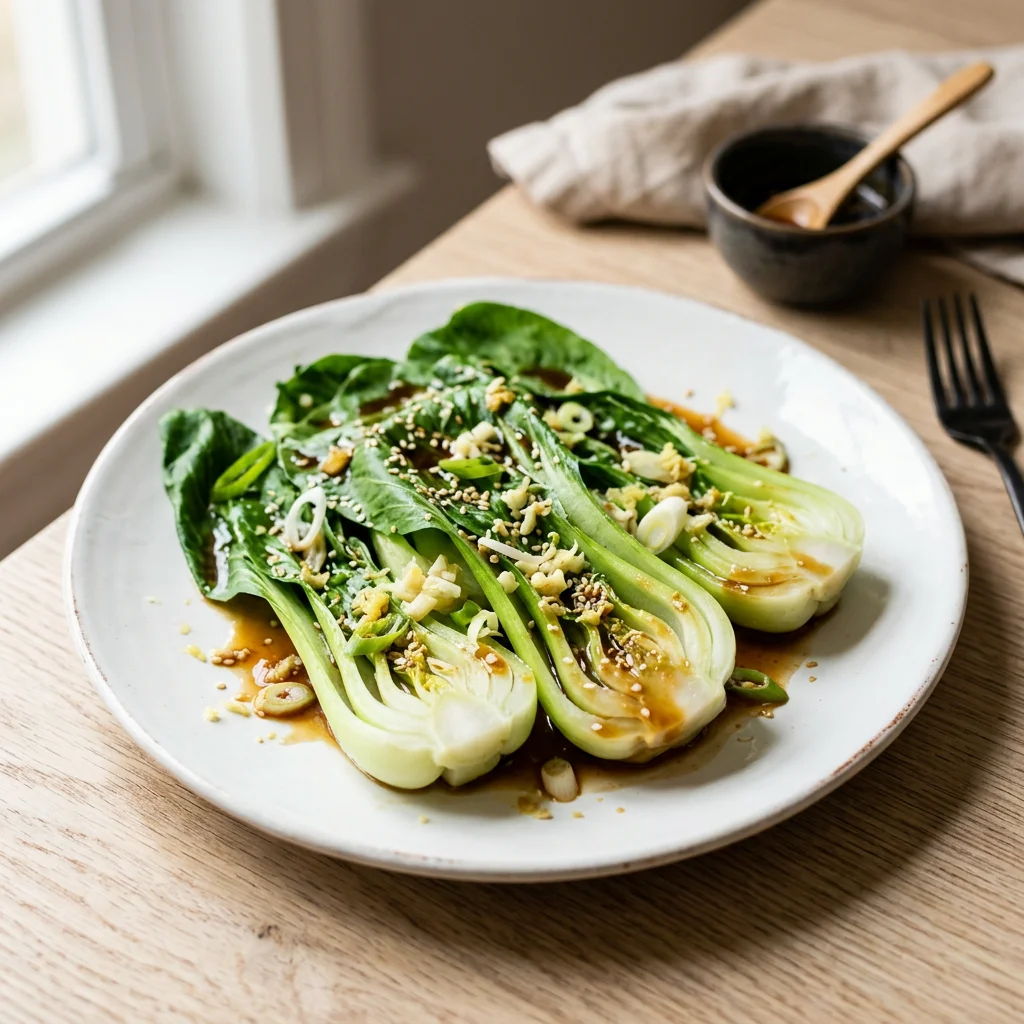
Steamed bok choy with ginger is the archetype of Chinese vegetable cookery — a preparation so simple that its quality depends entirely on the freshness of the ingredients and the precision of the technique. Baby bok choy is halved or quartered, steamed until barely tender, and dressed with a ginger-scallion sauce of hot oil, soy sauce, and sesame. The entire preparation takes under ten minutes. The result is clean, green, and deeply satisfying in a way that only the best vegetable cooking can be. Bok choy (pak choi) is a cruciferous vegetable that has been cultivated in China for over 5,000 years. Its mild, slightly sweet flavor and tender-crisp texture have made it the default green vegetable of Cantonese cuisine, where the philosophy is to let ingredients speak for themselves rather than drowning them in sauce. The ginger-scallion oil that dresses the steamed bok choy is itself a cornerstone preparation — hot oil is poured over minced ginger and scallion to release their aromatic compounds in a burst of sizzle, then finished with light soy sauce and a whisper of sesame oil. In TCM, bok choy is classified as cooling and sweet, benefiting the Stomach, Lung, and Large Intestine channels. It clears heat, moistens the intestines, and promotes digestion of heavier foods — which is why it appears alongside rich proteins in Chinese meals as a balancing element. From an Ayurvedic perspective, steamed greens dressed with ginger and sesame oil represent a near-ideal preparation: the slight cooking makes the nutrients more accessible than raw greens, the ginger kindles agni, and the sesame oil provides the oily quality that prevents the light, dry green from aggravating Vata.
Excellent for Pitta due to cooling, bitter quality of bok choy balanced by gentle warming ginger. Good for Kapha due to lightness and bitter taste. Mixed for Vata — the ginger and oil help, but the cooling, light quality can aggravate.
Ingredients
- 500 g Baby bok choy (halved lengthwise, rinsed)
- 2 tbsp Fresh ginger (finely minced)
- 2 cloves Garlic (finely minced)
- 3 whole Scallions (thinly sliced)
- 2 tbsp Light soy sauce
- 1 tsp Sesame oil
- 2 tbsp Neutral oil (peanut or vegetable) (for the sizzle)
- 1/2 tsp Sugar
- 1 pinch White pepper
Instructions
- Bring water to a boil in a steamer or wok fitted with a steaming rack. Halve the baby bok choy lengthwise and rinse thoroughly, especially between the inner leaves where grit collects.
- Arrange the bok choy in a single layer on the steaming plate, cut-side up. Steam over high heat for 3-4 minutes until the stems are just tender and the leaves have wilted but retain their vivid green color. Do not overcook — the stems should have a slight bite.
- While the bok choy steams, prepare the dressing: place the minced ginger, garlic, and scallions in a small heatproof bowl.
- Transfer the steamed bok choy to a serving plate, arranging it neatly. Drizzle with soy sauce, sesame oil, and a pinch of sugar.
- Heat the neutral oil in a small pan until it just begins to smoke — it must be very hot.
- Pour the smoking hot oil directly over the ginger, garlic, and scallion mixture. It will sizzle and crackle violently — this flash-cooking releases the aromatic compounds and creates the characteristic fragrance.
- Immediately spoon the sizzled ginger-scallion oil over the steamed bok choy. Sprinkle with white pepper.
- Serve immediately as a side dish alongside rice and a protein. Do not let it sit — the bok choy continues to cook in its residual heat and becomes waterlogged within minutes.
How This Recipe Affects Each Dosha
Vata
Bok choy's cool, light quality can aggravate Vata, but the ginger, garlic, and hot sesame oil dressing counterbalance this significantly. The brief steaming makes the vegetable more digestible than raw greens. Vata types can enjoy this regularly as a side dish (not as a full meal) when the ginger-oil dressing is generous.
Pitta
Bok choy is naturally cooling, sweet, and bitter — three qualities that directly pacify Pitta. The light steaming preserves the cooling quality while making it more digestible. The ginger adds mild warmth that aids digestion without aggravating Pitta. This is an ideal Pitta-season vegetable preparation.
Kapha
The light, bitter quality of bok choy is beneficial for Kapha. Bitter taste is one of the three tastes that reduce Kapha, and green vegetables in general help clear accumulation. The ginger and garlic provide warming stimulation. This is one of the best side dishes for Kapha constitutions — simple, light, and cleansing.
The bok choy itself has minimal agni impact — it is light and easy to digest. The ginger-garlic oil dressing provides the agni support, making this a well-designed preparation: the dressing serves as the digestive catalyst for the vegetable. Without the aromatic oil, plain steamed bok choy would challenge weak digestion. Together, the combination works.
Nourishes: Rasa (plasma), Rakta (blood)
Adjustments by Constitution
For Vata Types
Increase the sesame oil and add a few drops of toasted sesame oil for extra richness. Double the ginger and add a pinch of Sichuan peppercorn to the hot oil for deeper warming. Serve alongside warming rice and a rich protein — never eat this alone as a meal. Steam the bok choy 1 minute longer for a softer texture.
For Pitta Types
Reduce ginger by half and omit garlic. Increase the scallion greens (cooling) and decrease the white parts (heating). Skip the white pepper. A drizzle of rice vinegar instead of soy sauce creates a lighter, even more Pitta-friendly dressing. Add a squeeze of lime.
For Kapha Types
Double the ginger and garlic. Add fresh chili slices to the hot oil. Use mustard oil instead of neutral oil for extra pungent heat. Replace the sugar with a squeeze of lime juice. Add a pinch of turmeric to the dressing for extra drying quality. This preparation is already well-suited to Kapha and needs only intensification.
Seasonal Guidance
Best during Pitta season (summer) when cooling greens are most therapeutic and the body craves light, clean flavors. Excellent in spring for clearing accumulated Kapha with bitter, light foods. In autumn, increase the ginger and oil to counterbalance the cooling quality as Vata season begins. In deep winter, this becomes too cooling as a primary vegetable — switch to heartier, longer-cooked preparations like braised Chinese greens with ginger and star anise.
Best time of day: Lunch or dinner, always served as a side dish alongside rice and protein — not as a standalone meal
Cultural Context
Steamed vegetables with a hot oil dressing represent the purest expression of Cantonese cooking philosophy: the best ingredients, minimal intervention, precise technique. In Cantonese cuisine, the quality of a kitchen is often judged by its simplest dishes — perfectly steamed fish and perfectly cooked greens reveal a cook's skill more than elaborate sauces. Bok choy has been cultivated in the Yangtze River Delta region for over 5,000 years, making it one of the oldest cultivated vegetables in human history. The ginger-scallion oil technique (jiang cong you) appears across Chinese regional cuisines as a universal finishing method, reflecting the TCM principle that aromatic, warming condiments aid the digestion of cool, raw, or lightly cooked foods.
Chef's Notes
The hot oil sizzle is what transforms this from a bland vegetable side into something aromatic and satisfying — the oil must be smoking hot or the ginger and scallion will not release their full fragrance. Use a heatproof bowl and stand back when pouring. Baby bok choy is more tender and sweeter than mature bok choy; if using large bok choy, quarter it and steam 1-2 minutes longer. The soy sauce should be light (thin) soy, not dark soy, which would overpower the delicate vegetable. For an oyster sauce variation, replace the soy sauce with 1.5 tablespoons oyster sauce thinned with a splash of water. This technique — steamed vegetable with hot oil dressing — works with any Chinese green: choy sum, gai lan, Chinese broccoli, water spinach.
Frequently Asked Questions
Is Steamed Bok Choy with Ginger good for my dosha?
Excellent for Pitta due to cooling, bitter quality of bok choy balanced by gentle warming ginger. Good for Kapha due to lightness and bitter taste. Mixed for Vata — the ginger and oil help, but the cooling, light quality can aggravate. Bok choy's cool, light quality can aggravate Vata, but the ginger, garlic, and hot sesame oil dressing counterbalance this significantly. Bok choy is naturally cooling, sweet, and bitter — three qualities that directly pacify Pitta. The light, bitter quality of bok choy is beneficial for Kapha.
When is the best time to eat Steamed Bok Choy with Ginger?
Lunch or dinner, always served as a side dish alongside rice and protein — not as a standalone meal Best during Pitta season (summer) when cooling greens are most therapeutic and the body craves light, clean flavors. Excellent in spring for clearing accumulated Kapha with bitter, light foods. In aut
How can I adjust Steamed Bok Choy with Ginger for my constitution?
For Vata types: Increase the sesame oil and add a few drops of toasted sesame oil for extra richness. Double the ginger and add a pinch of Sichuan peppercorn to the h For Pitta types: Reduce ginger by half and omit garlic. Increase the scallion greens (cooling) and decrease the white parts (heating). Skip the white pepper. A drizzle
What are the Ayurvedic properties of Steamed Bok Choy with Ginger?
Steamed Bok Choy with Ginger has Sweet, Bitter, Pungent taste (rasa), Cooling energy (virya), and Pungent post-digestive effect (vipaka). Its qualities (gunas) are Light, Cool, Slightly Oily. It nourishes Rasa (plasma), Rakta (blood). The bok choy itself has minimal agni impact — it is light and easy to digest. The ginger-garlic oil dressing provides the agni support, making this a well-designed preparation: the dressing serves as the digestive catalyst for the vegetable. Without the aromatic oil, plain steamed bok choy would challenge weak digestion. Together, the combination works.
What should you eat today?
This recipe has specific effects on each dosha, and the right meal depends on more than general guidelines. Your constitution, the current season, your birth chart's active planetary period, what you ate yesterday, how you slept — it all matters.
With Personal Alignment, you get daily food and meal guidance tailored to:
- Your prakriti and current vikriti
- Your Vedic birth chart and active planetary cycles
- The season, weather, and time of day
- Your food preferences, allergies, and restrictions
- Your feedback — it learns what works for your body and adapts
Not a generic diet plan. A living system that gets smarter about you every day.